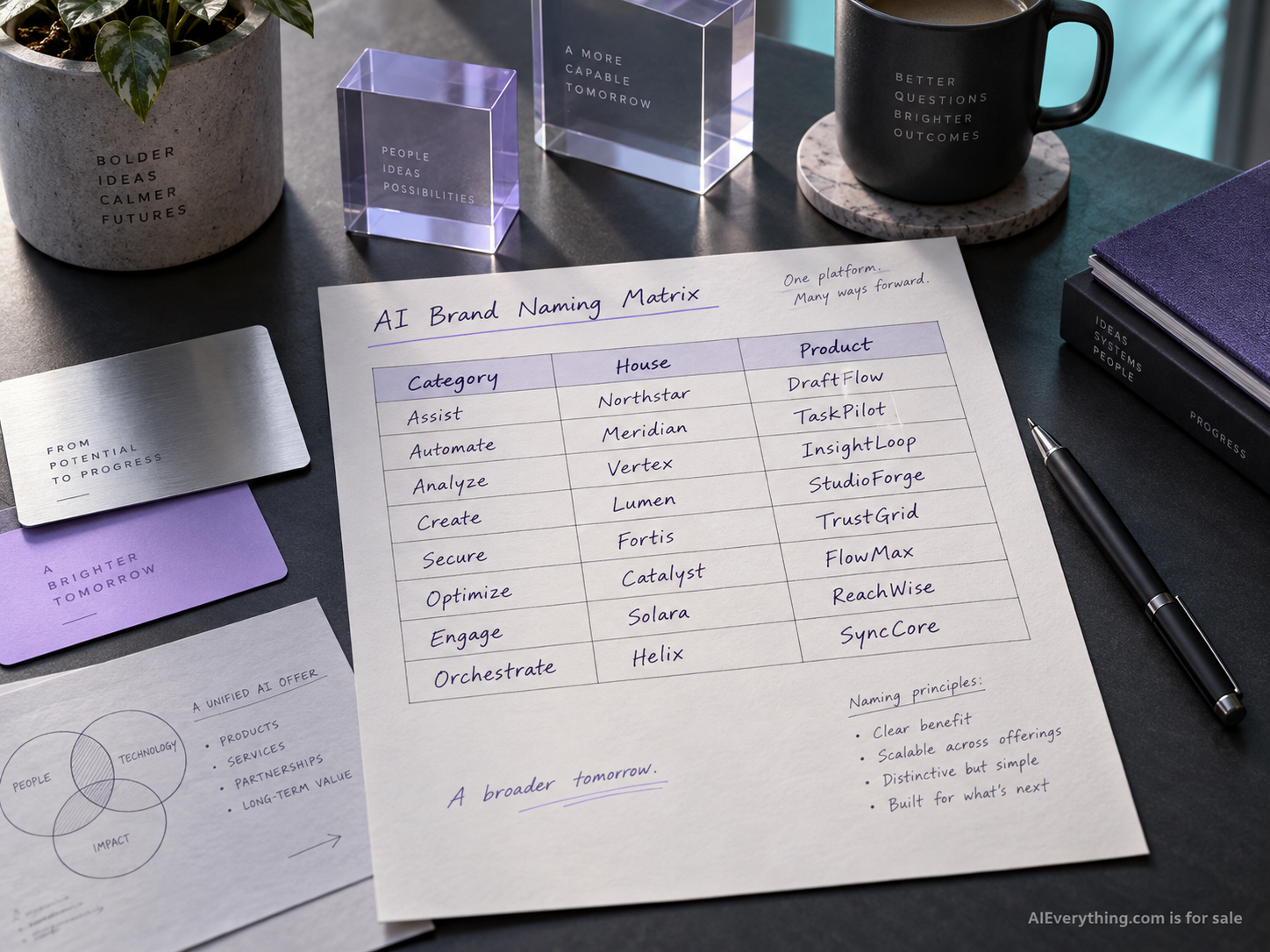
A broad AI offer needs more than an appealing name. It needs a naming structure that helps someone understand the business, find a product and recognize a feature without treating those three things as interchangeable. A company can have a wide ambition while its first product solves a narrow problem. The names should make that relationship easier to understand.
Start by drawing three rows on a page: the business, the products and the features. By the end of this exercise, each row should have a distinct job and the main brand should have a short, useful description. The examples are illustrative. They are intended to expose choices, not to suggest that any example name is available or cleared for use.
Separate the house, the product and the feature
The house name identifies the business or family of offers. It should remain useful when a product changes. A product name identifies something a customer can choose, buy or use. A feature name describes an action inside that product. Confusion starts when every small addition gets a separate brand or when a single feature is presented as the entire company.
Imagine a business helping teams prepare launch materials. Its house name could cover several tools. Its first product might be called Launch Workspace, while a feature inside that product might be called Source Check. The relationship is understandable because each name does a different job. A visitor does not need to learn three invented words before understanding the offer.
| Level | Question it answers | Illustrative role |
|---|---|---|
| House | Who is behind this? | AIEverything.com as the broad identity |
| Product | Which offer fits the task? | Launch Workspace |
| Feature | What can be done here? | Source Check |
Start with those roles before discussing the sound of individual names. If the team disagrees about which level a proposed name belongs to, the underlying product structure may still be unsettled. Resolve that disagreement on a simple page map. It is cheaper to change a working label now than to explain an inconsistent structure after launch.
Write the offer without the name
Temporarily replace the brand with a blank. Complete this sentence: “For [specific person], this [kind of offer] helps [task] by [actual action].” The sentence will probably be plain. That is useful. It forces the team to identify a customer, an offer type and a behavior before asking a name to carry the whole explanation.
For example: “For product marketers, this workspace helps prepare launch briefs by organizing approved source notes into a reviewable draft.” It leaves room for the brand to have personality while giving the visitor a concrete reason to continue. It also exposes questions the team must answer: who approves the notes, what the draft contains and what review is required.
If the sentence needs several unrelated audiences and actions, separate the offers. A house brand can support a portfolio without squeezing the entire portfolio into one line. Give each product its own description and use the main page to explain the relationship. Readers can then select a relevant path instead of decoding a list of capabilities.
Choose the amount of explanation deliberately
A category name can make the field apparent quickly. An invented name may give a business more room to establish a distinct identity, but it needs explanatory language around it. Neither approach removes the need for a useful product. The choice depends on how the name will be encountered and what the team wants a reader to understand first.
Think about a spoken introduction, a browser tab, a conference slide and a customer support reply. A name that depends on a logo may be harder to recognize in plain text. A long descriptive phrase may be clear on a page but awkward to repeat in a conversation. Test the actual contexts rather than deciding from a centered logo presentation.
Commercial clarity and trademark distinctiveness are separate considerations. The USPTO’s guide to strong trademarks distinguishes descriptive terms from more inherently distinctive marks. That is a reason to involve qualified counsel in the final choice, not a basis for declaring a candidate cleared. Owning a domain does not settle rights to use a brand for particular goods or services.
Test the description alongside the name
Prepare a plain version of the page with the proposed name, a one-sentence description and three product links. Ask a few people from the intended audience what they expect to find. Avoid first explaining the concept; that would test their memory of the explanation rather than the page. Listen for their interpretation of both the scope and the intended customer.
Record the words people use, including uncertainty. If they expect a directory but the business sells software, the description needs work. If they expect an autonomous service but the product prepares drafts, change the action verb. These observations do not prove market demand. They help identify places where the language creates the wrong expectation.
Repeat the exercise with a spoken introduction. Say the name once, use it in a sentence and ask the listener to write the address. Watch for spacing, spelling and extension errors. A small test is a diagnostic, not a statistical claim about memorability. Keep the observations with the naming shortlist so later discussion is based on something more concrete than preference.
Keep capability claims out of decorative language
Words such as “autonomous,” “accurate” and “secure” carry expectations about behavior. They should not be added merely because the page feels empty. A feature that drafts a response for approval should say that. A system that acts without review needs a precise explanation of the circumstances in which it does so.
The FTC’s advertising guidance states the general expectation that advertising claims be truthful and evidence-based. For a naming exercise, the practical lesson is to distinguish a broad identity from a factual promise. Keep evidence for the latter and have the relevant specialists review claims that require it.
Place limits where the visitor makes a decision. A short note near a feature can explain accepted inputs or required review. A distant disclaimer cannot help a reader who has already formed the wrong picture from the headline. Clear boundaries also give the product team a more useful basis for deciding when the description must change.
Make the naming map survive the second product
Before choosing the final structure, invent a plausible second product and place it next to the first. This is a planning exercise, not a promise to build it. If the new product requires renaming the company, the house name may be too narrow. If nobody can tell the products apart, the individual names may be too vague.
Write a short internal rule for each level. The house identifies the field; product names identify a customer job; features use familiar action words. The exact rules can differ, but they should be brief enough that another writer can apply them. A naming system is useful only if it helps future decisions.
Finish by rewriting one broad claim into a specific description. Replace “AI for every business challenge” with the real customer and first task. Then place that line beneath the candidate name and read it aloud. AIEverything.com is one possible broad identity; the quality of the offer description will determine how clearly that identity reaches a buyer.